All About the Interview
You are one major step further in the application process. However, for many people, the job interview is the greatest challenge. While you were able to revise your CV several times, there is no second chance during an interview. You need to be prepared from the outset. Good preparation is therefore essential.
During the interview, your goal is to confirm the positive impression created by your application documents. We have compiled several resources to support you in preparing for the interview. Below, you will also find tips on salary.
There is no fixed structure for a job interview. However, you can generally expect the conversation to cover the following topics, although the order and focus may vary:
- Welcome and introductions
- The company introduces itself and the position to be filled
- The candidate introduces themselves and is interviewed
- In-depth discussion of the role
- Questions from the candidate
- Possible discussion of contractual conditions (for internships, often during the first interview; for trainee or entry-level positions, frequently only during the second interview; salary expectations may be discussed during the first interview)
- Closing and farewell
Interview Checklist
Here you will find a checklist to support you in preparing for the interview.
In job interviews, a distinction is generally made between structured, semi-structured and unstructured interviews. It is common for a combination of these formats to be used during one interview. To prepare effectively, it is therefore helpful to have a basic understanding of the different methods and techniques.
The Structured Interview
In a structured interview, the interview process is fully predefined for the interviewer, and all applicants for the position are asked the same questions. This method allows the company to compare candidates effectively, as the interview tends to follow a question-and-answer format rather than a discussion. If you notice this during the interview, it is important to include all relevant information in your answers, as few or no follow-up questions may be asked.
The Semi-Structured Interview
The semi-structured interview is also known as a partially structured interview. Most questions are prepared in advance, but the interviewer can determine how they are asked and in which order. Most interviews follow this format. You can recognise it when the interviewer follows a question guide but also responds to your answers and may ask follow-up or additional questions.
The Unstructured Interview
Unstructured interviews are not prepared using a fixed interview guide. The interviewer may only note down the general topic and a few key points in advance. The structure and process are usually intuitive. This type of interview is relatively rare. You can recognise it when the person interviewing you has no fixed or written questions. This gives you some opportunity to steer the conversation in a particular direction. At the same time, interviewers can explore specific topics more deeply and ask further questions when something interests them.
Possible Interview Questions
Here you will find possible questions that you can use to prepare for an interview. This is a list of typical interview questions that may repeatedly appear in job interviews, even if they are phrased differently.
Consulting Interview Questions
Here you will find various examples of questions used in interviews for consulting positions.
Consulting Interview Questions
Questions for the Interviewers
Whenever an HR professional asks whether you would like to know anything else or have any questions, you should never remain silent or shake your head. You should ALWAYS have your own questions prepared. Here are a few examples.
Questions to ask at the job interview
STAR Method for Interviews
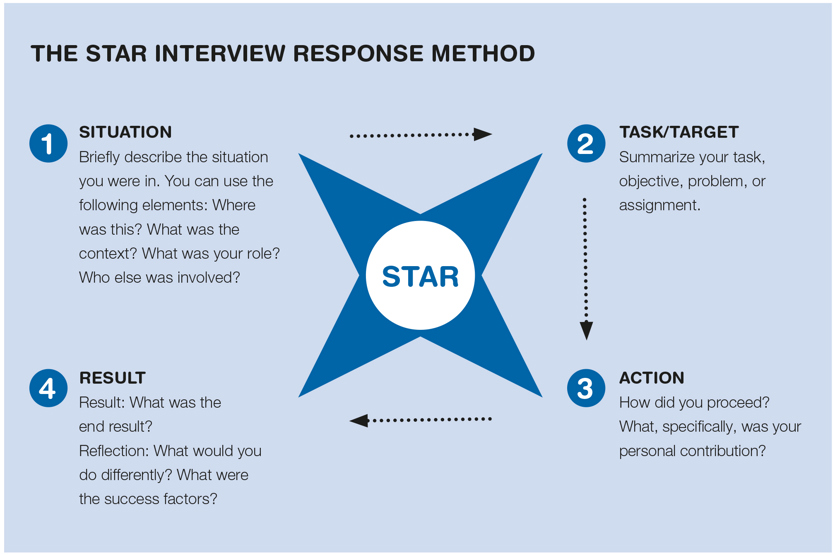
The STAR method helps you structure your answers and describe evidence from your experience. It is particularly useful for competency-based questions.
The STAR method, also known as behavioural interviewing, originally comes from the United States. The renowned Massachusetts Institute of Technology (MIT), for example, also recommends it for storytelling and argumentation during interviews. It mainly helps you maintain a clear line of thought and avoid getting lost in unnecessary details.
Situation: Briefly describe the situation, including elements such as where it occurred, the context, your role and who was involved.
Task/Target: Your task, goal, problem or assignment.
Action: How did you proceed and what did you personally contribute?
Result/Reflection: What was the final result?
Reflection: What did you learn? What would you do differently, or what were the key success factors?
Example: “Company XY hired me for an internship to support the development of business area ABC, which did not previously exist there. My task was to contribute to its development. Within the team, I was responsible for XYZ and helped increase revenue in this business area by ZZ per cent within six months.
In addition to preparing the content of an interview, functioning technology is another essential requirement for success. Here are further points to keep in mind.
- Make sure you know which online interview tool the company uses. Check that the tool works properly on your device. Review your settings and profile name once again.
- Test your webcam, microphone and LAN or Wi-Fi connection in advance, for example by having a test call with a friend. Keep a backup device available in case your main device fails during the interview.
- Choose the right camera framing. Check in advance how you appear on camera. Is the framing suitable? Are you clearly visible and large enough in the image?
- Ideally, position the camera slightly above you. An ironing board or stack of books can also serve as a laptop stand. Your eyes should be positioned in the upper third of the image. To make direct eye contact with the person you are speaking to during a video call, you need to look into the camera rather than at the screen. Most applicants instinctively look at the other person’s image on the monitor. To them, however, it may appear as though you are looking slightly past them. And do not forget to smile. It immediately makes you appear more approachable. Professionals sometimes place a Post-it with a smiley face beside the camera as a reminder.
- If you definitely want to use your smartphone for the video interview, either use a proper phone tripod or position the phone securely at eye level.
- Check whether your face is well lit and whether there are any unattractive shadows beneath your eyes or in the background. Daylight is the best and cheapest form of lighting. Ideally, sit at a desk facing a window. Otherwise, use lamps that illuminate your face sufficiently without creating too many shadows.
- Sound is just as important as the image. Many webcams have an integrated microphone, although the sound quality can be poor, especially with cheaper models. You will usually achieve better sound with an external microphone, a computer speakerphone or a good wired in-ear headset with an integrated microphone.
- Pay attention to the background. It should be as neutral as possible. Busy walls, striking pictures, holiday photos and untidy shelves make a poor impression or can be distracting. If you do not have a suitable background, use a neutral virtual background if the tool allows it.
- Body posture also matters in a virtual setting. Sit upright, keep your hands calmly on the desk in front of you and use appropriate gestures to support what you are saying.
- Make sure the room is quiet and switch off all possible sources of disruption. This means closing all active applications on your computer, switching off your mobile phone and telephone, and closing the door and windows to avoid background noise, traffic noise, interruptions or people calling out. You should also inform any housemates about the interview so that they do not unexpectedly walk through the picture or make too much noise.
- You may place Post-it notes with important content, such as strengths, your USP or the names of contact persons, around the edge of your screen. This can provide reassurance without requiring you to look down at your desk.
- Finally: practise, practise, practise. Record yourself, for example using Zoom or another video conferencing tool, or ask friends for feedback.
The amount of your salary depends on the industry, the size of the company and, of course, your position. There are also regional differences, not only within Switzerland but in other countries as well. You should also consider not only the salary itself, meaning the figure, but the overall employment conditions.
Total compensation can generally be divided into the following components:
- Basic salary (annual salary, paid in 12 or 13 instalments)
- Performance bonus
- Employee benefits (not exhaustive)
- Pension fund contribution
- Number of holiday days
- Contribution towards public transport, e.g. Half Fare Travelcard or GA Travelcard
- Company car
- Discounts on products
It is particularly important to inform yourself in advance about your market value. When asked about your salary expectations, the amount usually refers to annual salary rather than monthly salary.
Example: Salary expectation of CHF 80,000 per year (although this refers to the actual salary amount and does not necessarily include employee benefits)
The following websites provide an indication of possible salaries and compensation packages (not exhaustive):
jobs.ch Stadt Zürich Präsidialdepartement bfs.admin FH SCHWEIZ SGB | USS berufsberatung.ch