Job and Internship Search
Searching for a job involves more than simply looking for vacancies and sending your CV to employers. To find a suitable position, you should be clear about what you are looking for and what you can offer.
Do you already have a clear idea of where you would like to work, how your preferred company should be structured, what you expect from your immediate working environment and what is personally important to you? Very good.
If not, please visit the Career Planning section, where you will find a step-by-step guide to help you plan.
Here are some tips to improve your chances of securing the position you want:
- Know your career goals
- Plan ahead
- Research companies (see below)
- Identify examples that demonstrate your skills
- Apply with confidence
- Arrange informational interviews
- Network regularly and, above all, start early (see below)
- Use a variety of channels in your job search
- Activate your professional network – many positions are filled internally and are no longer advertised publicly
- Explore the possibilities offered by AI (see below)
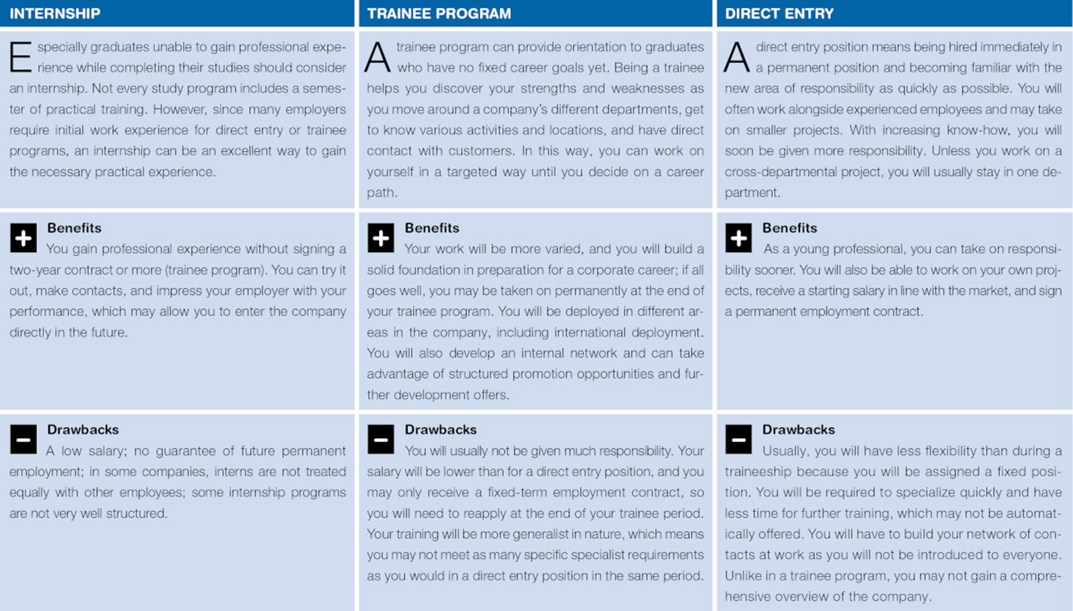
Graduates can choose between direct entry, a trainee programme and an internship. Based on your academic background and previous practical experience, you need to decide which path will best support your future career. Your personal attitude, level of commitment and the amount of responsibility you would like to take on are also important factors. For example, if you are aiming for a management position, a trainee programme is ideal preparation for you as an emerging talent. With direct entry, promotion may not necessarily be planned during the initial period, but it is still possible. With some luck and a high level of commitment, you may also quickly move into a management position. Here, we explain the differences between an internship, a trainee programme and direct entry and outline the advantages and disadvantages.
Should you have any further questions, please feel free to contact us.
Networking – Career Fairs and Events
Learn more about potential employers and expand your network.
Career Services ZHAW SML Events
Conecto ZHAW Career Fair
Company Profiles
You can research information about companies on the following websites.
Company profiles of partner companies Xing LinkedIn
Greatplacetowork Glassdoor Kununu
Job platforms and job boards
Job platform with current job postings by our corporate partners and other companies.
Here you will find an overview of existing job boards in Switzerland and industry-specific platforms.
Job search engines
Search engines that search all job portals in Switzerland for relevant jobs:
Discover internships abroad and start your international career.
For ZHAW-SML students.
The Swiss Centre of Competence for International Cooperation provides information, advice, and training.
Gainful employment in Switzerland while studying or doing an exchange year: What do you need to know, and what should you bear in mind?
You can accept paid part-time employment of up to 15 hours per week during the semester. During the lecture-free period, employment of up to 100% is possible. In both cases, however, your employer must obtain a work permit from the Swiss Office for Economy and Labour (AWA) for students from third countries (non-EU countries, including the UK). This is only possible once a residence permit has been obtained.
Doing an internship while studying in Switzerland
International students who are enrolled at a Swiss university (of applied sciences) and are required to complete a compulsory internship or wish to write their thesis involving a Swiss company may be granted permission upon request if gainful employment does not exceed half of the total duration of the program and if the salary and working conditions meet requirements.
Permanent employment in Switzerland for foreign graduates
Third-country nationals with a Swiss university degree are allowed to find work under certain conditions. Not every degree completed in Switzerland automatically entitles the holder to pursue gainful employment. Only areas in which there is not already a sufficient supply of staff are eligible.
Gainful employment will be permitted if…
- the job is of high scientific interest, such as in research and development or the application of new technologies, or
- the activity is of high economic interest, such as if it contributes to the creation of new jobs or generates new orders to benefit the Swiss economy.
The employer must apply for the permit. The priority of nationals is not checked. Otherwise, the provisions applicable to third-country nationals apply.
This information does not claim to be complete and must, in any case, be checked in advance by the persons concerned.
Useful links:
Kanton Zürich – Students and Interns Migrationsamt Kanton Zürich Amt für Wirtschaft und Arbeit Zürich – Office for economy and labour
Staatssekretariat für Migration - State secretariat for migration a-link.ch Aiesec IAESTE