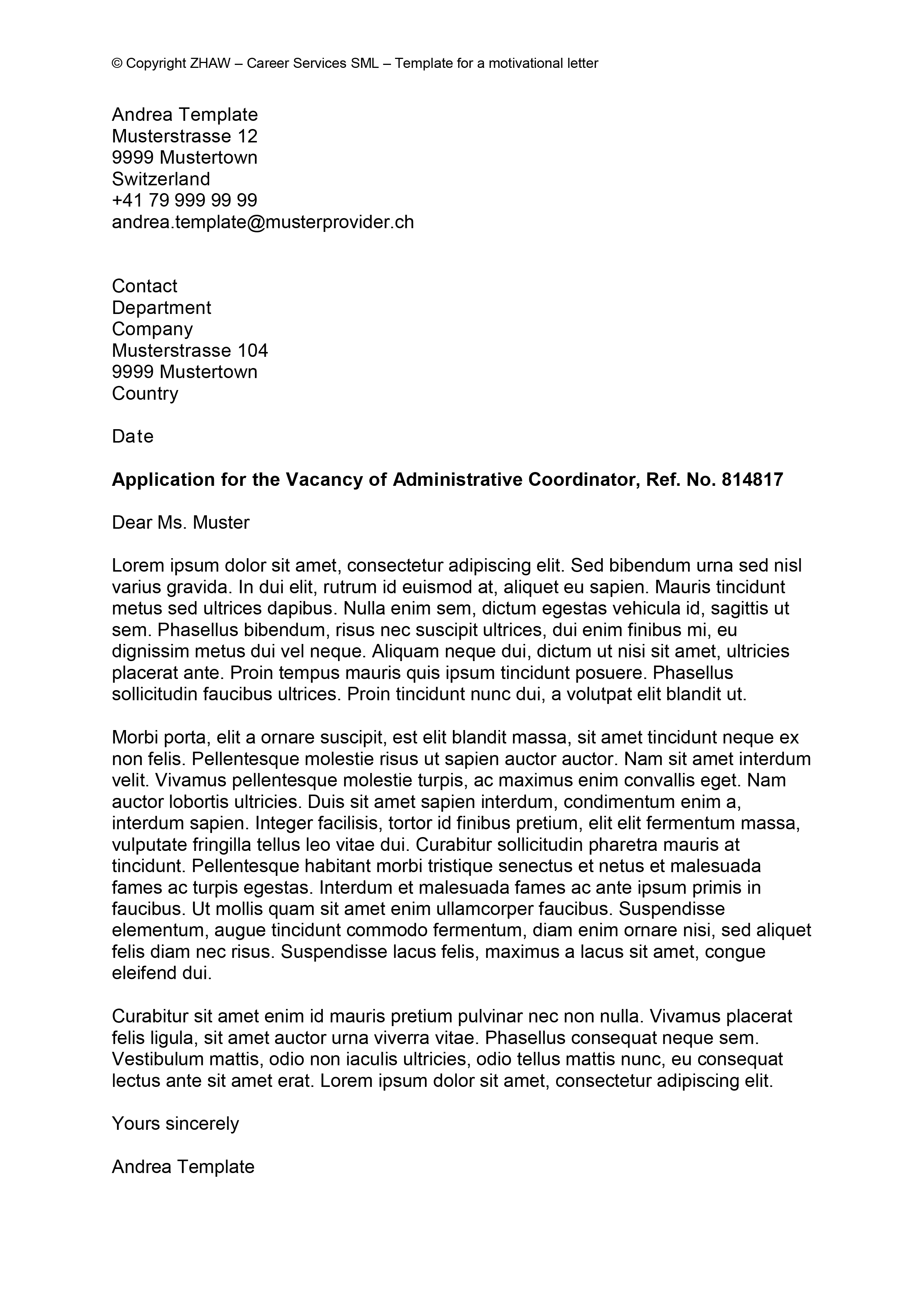
In this section, you will find information on the structure and content of a letter of motivation. The letter of motivation is a document that allows you to show your motivation and qualifications for the job you are applying for. Therefore, it is important to tailor it to the specific position and the company’s requirements. Many recruiters will read your CV first. Therefore, do not repeat in your cover letter what already is in your CV.
- Address
- Place and date
- Meaningful subject line
- Greeting
- “YOU” – The company and the position I am interested in
- “ME” – My professional experience and key skills
- “WE” – What the company and I could achieve together
- Closing
Personal contact details:
First name last name
Full address
Email
Phone number
Company address details:
Company name
Department
Contact person (If you do not have a specific contact person, use the department name, e.g., HR)
Meaningful subject line:
The exact name of the position you are applying for. Add the reference number (if available).
Greeting:
Address your contact person. If this person is not known, use a standard form of address: “Dear Sir or Madam.”
This is the most important part of your letter of motivation. Here you describe the highlights of your profile that qualify you as a serious contender for the job. Giving your letter of motivation a clear structure takes time; the literature talks about one working day.
“YOU” – The company and the position I am interested in
Why do the company and the job interest you? Explain the reasons for your interest. Describe your motivation and mention as many points of contact as possible (guest lectures, career fairs, acquaintances, career events at your university). Be specific and think about why the company interests you. Describe this in concise sentences. This way, you will appear authentic and original rather than someone who copies well-used phrases.
“ME” – My professional experience and key competencies
Why do you think you are the right person for the job? Which of your qualifications and skills are relevant to the company? Give examples from your experience of applying these relevant skills and relate them to the requirements stated in the job advertisement. Take three to four of the relevant skills and link them with examples instead of simply listing them.
“WE” – What the company and I could achieve together
This is the concluding part. Summarize your key messages here. What can we - the company and you - achieve together? Compose a closing sentence in which you say thank you and communicate your desire to learn more about the company and the job.
Salutation and signature:
If you need to upload your documents digitally or send them via email, your name will be sufficient as a signature. You could also include a scanned copy of your signature.
AI tools can help you collect ideas, organize your thoughts, and refine your wording. However, your letter of motivation should always reflect your own story, your motivation, and your language. Use AI suggestions to inspire you but adapt them consistently to your personal style and the Swiss context.
If you find it difficult to get started, you can ask an AI tool for wording suggestions.
Example formulation for an AI tool: "I am applying for a job as a [position] at [company]. I would like this position because [short description of your motivation].
Formulate three different introductory sentences that
You can use an AI tool to organize your thoughts based on the YOU-I-WE structure.
Example formulation for an AI tool: "I am applying for the position of [X] at [company].
YOU: What I know about the company: [info, e.g., industry, products, values] I: My relevant experience and skills: [description] WE: What I can specifically contribute: [ideas on how to add value without being pretentious.]
Help me to formulate a coherent text that
If you already have a draft, an AI tool can help you check its structure and comprehensibility.
Example formulation for an AI tool: "Here is the draft of my motivation letter: [insert text]
Give me feedback about
To avoid your text sounding generic or being "typical AI," a clear, specific reference to the potential employer is important.
Example formulation for an AI tool: "I am applying to [company]. I have researched the following information about the company: [Info from website, news, LinkedIn, or Perplexity research].
Help me to formulate a short paragraph that
Use AI tools as a sparring partner, not as a replacement for your own ideas. Always check whether you recognize your own voice in the text and whether it matches your profile and the Swiss job market. If in doubt, you can have your letter of motivation proofread by Career Services.
Do you have any further questions? Then register for one of our services.